(1842-1927)
Vilhelm Thomsen, (1842 - 1927), Danish philologist. For many years Thomsen was professor of comparative philology at the Univ. of Copenhagen. His best-known work was the decipherment of the bilingual Türkic-Chinese inscription found on the Orkhon River in Mongolia. The inscription, published in 1894, at the time was the most ancient form of Türkic yet found. (And don't believe claims that the Orkhon inscriptions are the oldest, or found in some "encyclopedias" that Thomsen was great because he worked on IE languages!)
Posting notes and explanations, added to the text of the author are shown in (blue italics) in parentheses and in blue boxes, or highlighted by blue headers.
From the book of Murad Adji
Europe, Turks, Great Steppe
AST, ISBN 978-5-17-051352-9
Wild Field - Great Steppe
"What Huns?", "What these barbarians have to do here?" - inquired many, having read the irreproachable work of the outstanding Danish scientist who convincingly proved that history of Europe without the history of the Türks is empty.
Vilhelm Lidvig Peter Thomsen was born in a mailman family in the small town Randers, there went his childhood, there he began his university career. Theology did not attract the young man, and he engaged in other sciences - philology and botany. Thomsen was lucky, he had outstanding teachers who noted his phenomenal memory and discovered in the young man a gift of a philologist.
He was brought up in the best traditions of the classical European schooling, with a combination of laboratory and field research. During his travels before the inipient scientist came alive the inimitable world, and in the libraries opened the bygone world. The Arabian, Persian, Japanese, Chinese, Gypsy, Thomsen acquired tens of languages until at last he got acquainted with exotic for the Europe Turkic language.
The scientist sensed in it a certain mystery, his heart sensed it as an "ancestral home" of some European languages, their linguistic base, but for a long time his mind opposed the inside voice. Until a cause came about.
In 1887 Thomsen was invited to a professor position to the faculty of comparative linguistics in the Copenhagen university. He gained a global fame during those years for his work about ties of the Old Rus with Scandinavia, and about the origin of the Rus state. (Specifically Rus, not the Slavic!). It would be fair to say that the research of the Danish professor expressed views which drastically differed from the version adopted in Russia. In fact, professor Thomsen was one of the first scientists who wrote truthful, without the politics!, history of Russia as it factually was. His work was accepted within the world community, it became classical, it is used to teach students.
Because of the inability neither to deny nor to accept the conclusions of his fundamental research without legends and fictions, the name of the professor Thomsen was made if not outright forbidden then at least not known among the Russian scientists, in Russia his works are almost unknown: only one small article was translated and published, no others could be found. What a pity! From them the world learned the truth about the Kievan (Kyivan) Rus.
Professor Thomsen visited Russia many times, knew excellently the European (Venedian) roots of the Slavic culture. This outstanding linguist found out what always dodged the focus of the Russian scientists, he revealed the Türkic base of the culture which nowadays is wrongly referred to as Russian.
Maybe not. The respectable professor just scientifically proved what was known for a long time. There is a saying: "Scratch any Russian, and you'll find a Tatar". Thomsen just scratched the Rus.
It all began with the written monuments found then in Russia, or more truthfully, in Southern Siberia, in the ancient native land of the Türks . These monuments were forgotten for more than a thousand years. Studying history of the "infidel" peoples did not interest the Russian science.
That is why the finds of Daniil Gotlib Messershmidt were left without attention. This scientist from Dantzig was the first among the Europeans who in the 1719 - 1727 traveled to Siberia. Near Nerchinsk, Messershmidt was shown remains of an ancient cemetery where remained two freakish stones covered with relief images and inscriptions. There is an opinion, that the first discoverer was a captured Swedish officer F. Stralenberg, who saw the mysterious rock signs in 1713 - 1722, while living in Siberia, and he referred to them as runic because of the outward similarity with the Germanic runs.
Everything was clear with the images: pictures of hunts and sacrifices, animals, people, ornaments were executed with exceptional art and harmony. To the German scientist, the written symbols appeared familiar, reminiscent of ancient Germanic runes. But he swept aside this guess: it was too far from Siberia to Germany.
In the St. Petersburg the Messershmidt's finds were received without delight, as though they were known for a long time. The copies he made from most unique monuments were not even looked at, not to mention publishing them. The writing was ordered to be classed as Scythian, and suggested to archive copies as worthless material.
Later, with the help of one of the Catherine II ambassadors, these copies were secretly sent to Europe and published there. Evidently, thievery and trade in smuggled antiquities were already practiced in Russian science. So, the world learned about one of the forgotten pages of history, although the subject was not an ancient Türkic culture.
The Siberian stelae with strange graphemes became subject of discussions. It all looked too mysterious and majestic. Especially after a public discourse of the abbot Balia about Siberian Atlantis and Atlantians-Siberians who perished under mysterious circumstances.
Certainly, the Messershmidt's publication did not pass unnoticed. From that time, for many European scientists hunting for antiquities from Siberia became a passion. Not only Siberia, but the entire Russian steppe also, and its kurgans, were generously endowed with rarest artifacts of culture, they were being bought for a song. During this robbery, we lost uncounted treasuries, and they found uncounted treasuries.
By the beginning of the 19th century a few monuments etched with mysterious writing were found in Southern Siberia. In the steppes of Russia clearly appeared traces of surprising unknown culture, which attracted, alas, not the researchers, but adventurers.
In Paris, the world center of oriental studies, almost every year were discussed new and new finds brought over from the steppes of Russia. Certainly, possessors did not advertise many finds, to avoid clashes with law: possession of gold objects required documentation.
At last, Parisian orientalists thought that enough material was collected, and it is possible to attempt to decode mysterious writings. The first to accept the responsibility were the academicians J. P. Abel-Remusat (1788–1832) and his eternal opponent in the scientific discussions Julius Klaproth (1783-1835). Both of them, the best authorities on ancient history, like titans tried to move mountain. It all was in vain. It was not even possible to determine to what group of languages the mysterious script belongs. The enigma that covered finds became only thicker.
There was no lack in hypotheses. The artifacts did not give any respite to archeologists. Some were inclined to a version of the Scythian roots. Was even invented a people "Chud" ("Wonder, Strange" in Russian - Translator's Note). However, a majority of the researchers converged on recognition of the new script as ancient Germanic runes, due to their almost full outward similarity. That was done without any substantiation, just to attribute, period.
As frequently happens in science, the futility, the absence of fresh ideas little by little cooled interest to the mysterious monuments, and they again went into oblivion, waiting for their hour.
An interest to the Siberian finds woke up in 1875, when a Finnish scientist M.Kastren returned from a Minusinsk expedition. He published a work under a name "Yenisei inscriptions". It was, perhaps, the most detailed and complete work. It had everything that an insatiable soul of an archeologist could wish. A last word was left to the linguists, but they were silent. They had no clue! (On the myopic Russian calendar, still the first was N.M.Yadrintsev in 1889, see Wikipedia to believe)
The agitation among the foreign researchers seems to have woke up Russia. At the 8th Russian congress of archeologists, as they say, N.M.Yadrintsev "Discovered America": having visited Manchuria, he found what was already studied for more than a century by the European archeologists. The Yadrintsev's report was “acknowledged”.
And in the meantime, in the spring of the 1890, in a completely deserted area near Orkhon river close to lake Kosho-Tsaidam a Finnish researcher A. Heikel found two more ancient monuments. The exhilaration of the scientist, who reached the site with his brother and wife, was limitless.
The first monument was a gigantic stone slab that reminded a grave stone. By its position Heikel guessed that it was knocked off a pedestal. Evidently, there was a grandiose structure with only ruins remaining... Who, earthquake or people destroyed the monument? It is unknown.
Among the remaining ornaments was possible to discern dragons, and small pentagonal tablets with inscriptions. But most of them looked ruined, erased by ruthless elements. Gathering what was possible to get from the monument, Heikel draw a conclusion: this was a Chinese work.
One little detail was confusing, the Chinese inscription covered one side of the stele. Three others seemed to have inscriptions similar to the ancient Germanic runic alphabet. The same as on the other Siberian finds. How come?
Near the slab, whch in the opinion of the scientist surely was a knocked down stela, stood a large quadrangular altar. Next to it were remains of a long structure sunk into the ground. Heikel made a plan of the monument. And he started digging. Soon appeared a covered with dirt brick wall. Using their shovels, the archeologists found seven statues with heads broken off. They obviously were not of Chinese work. Looking at them, Heikel understood that the hypothesis about their Chinese origin must be discarded. Clothing and weapons known from finds at the Don, Danube, and other areas of the forgotten Desht-i-Kipchak pointed to the Türks.
However, this discovery did not add any clarity: What Türks had to do with this? What connection these savages could have had with such high culture being examined by the archeologist?
A kilometer from the site, Heikel and his team found one more exactly identical monument, only larger in size. It also was covered with inscriptions, part of which, unfortunately, was obliterated. And again, one side of the monument had Chinese hieroglyphs, and three others had inscriptions in already familiar "unknown" script, apparently Türkic.
He and his comrades did not suspect yet that they found tombstones of prince Kül-Tegin and his brother Bilge-Kagan. They copied inscriptions and departed, and published them in 1892 in Helsingfors (Helsinki; during 1809—1917 Finland was a Russian colony). It looked like the mysterious inscriptions were getting an owner, though everybody surely knew that ancient Türkic writings never existed, those people were too uncivilized. They were barbarians!
More than enough information about the mysterious "Siberian inscriptions", as they were cautiously called, was accumulated already. Their traces were also recorded in the finds around Urals, Itil, Don, Dnieper, Danube, all over the steppe. It only remained to find a person who would read what was collected by archeologists in a hundred years.
And fortunately, such a person was found. Truth is, at first nobody appreciated the thinnest (only few pages!) report presented to the Danish Royal Scientific Society. Report was signed with a name that did not mean anything to the archeological world, one V.Thomsen, a faculty professor of comparative linguistics in the Copenhagen University. It happened on December, 15, 1893, a date of rebirth for the Türks!
Copies of the inscriptions with mysterious "Siberian" writings came to the professor Thomsen entirely accidentally. And in a happy minute. At first he established a direction of the writing, to find out how to read the inscription. It turned out the writing went not from left to right, like the Mongolian, but from right to left, similarly to the vertical lines of the Chinese writing.
Next step was to calculate the number of the letters. That also did not exhaust the venerable professor. It allowed to conclude that the system of writing was a unique, stand alone previously unknown system in-between the alphabetical and syllabic script types practiced in the West and in the East.
And then, everything became very comprehensible to a man who knows three dozen languages. The first word read by the Danish professor Vilhelm Thomsen was "Tengri". That was a Divine omen! It was the first word that came out of the silent stone.
The scientist did not know the meaning of this unknown word, only later from the context he guessed that the subject is "Heaven", "Heavenly God".
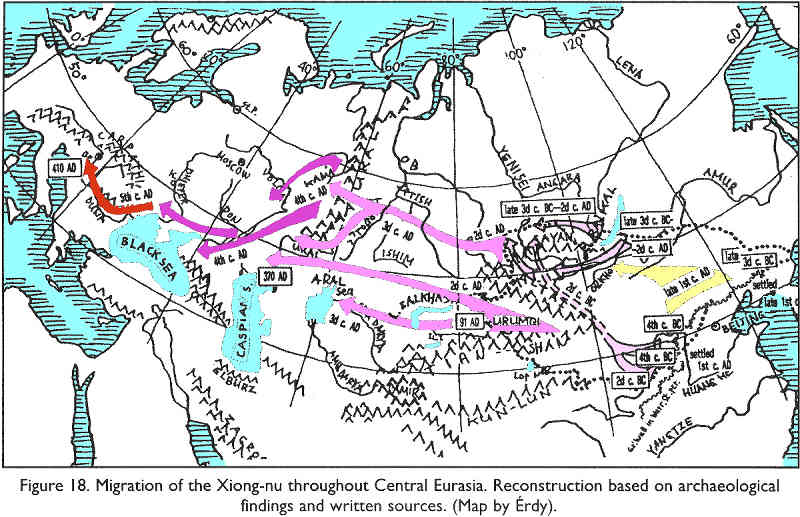
So, this is how it happened. The Great Tengri-khan in the 19th century launched the ancient Türkic writings, which was believed not to exist, but which in the 2nd century diverged from Altai to Europe, and got lost there together with Kipchaks (Allusion to the Hunnic migration in the middle of the 2nd c. AD from Altai to S.Urals and ultimately to Europe).
Thomsen read the language belonging to the people whom the Chinese called "Tu-Kue" (突厥 Tujue or Tukue). It was a purest Türkic language, a dialect much more ancient than all the Türkic dialects known at that time.
After his discovery the Dane Thomsen became an outstanding expert on Türkic dialects, soon he could freely read, write and speak in the language of Attila. By the diligence of the professor from Copenhagen the Türkic alphabet was raised from the tenacious paws of oblivion. It became clear: was discovered unique, almost unknown culture, whose carriers were the "Huns", "barbarians", "Goths" etc. - in a word, the Türks - Kipchaks. It already became impossible not to acknowledge their culture.
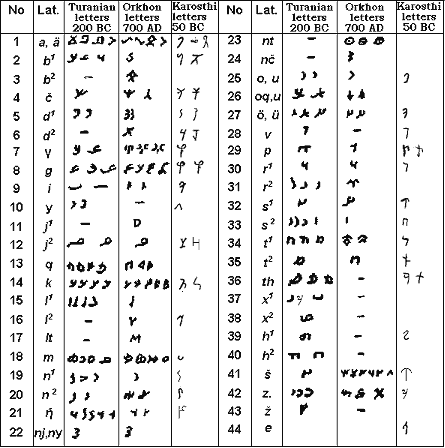
Three years passed since that triumphal December evening in the Danish Royal Scientific Society where professor V.Thomsen gave the shocking account. Was published a book of the scientist, where behind laconic name "Deciphered Orkhon Inscriptions" lay a key to perusal of ancient Türkic texts. The book published not only the full alphabet, but also annotated translation of all then known inscriptions. It was in essence a first and only textbook in the world on the grammar of the Türkic language, about which the Kipchak descendants in Russia apparently have never heard.
There were no more doubts (and the later research have confirmed it): in the territory of Southern Siberia five centuries prior to the new era stood a majestic empire (Apparently, reference to Arjan-Pazyryk and Issyk kurgan burial monuments). It has lived its life, leaving written and material traces. And by the first centuries of the new era the people were gone. Where to? How? Why? Nobody knew.
Jumping ahead, we shall note that the feeling of path blazers have felt, besides Messershmidt and his followers, the magnificent Russian archeologist S.I.Rudenko, and his Siberian colleagues led by the academician A.P.Okladnikov. They, but already in the 20th century, have discovered their Siberia, that bygone empire whose existence European archeologists suggested in the 19th century.
So, in the 19th century the world learned what in the stone messages the ancestors sent to their descendants. Stones started to talk. The true history of Türks, silent for centuries, started talking.